


Spend More, Save More on Shopify: Minimum Purchase Tiers
Spend $100 get 10%, $150 get 15%, $250 get 20%: how to build it on Shopify, show shoppers the next tier, cap the saving and pick thresholds that pay.

In Discounty: Cart goal See how a Shopify cart discount works
To run "spend $100 get 10%, $150 get 15%, $250 get 20%" on Shopify, you need either three separate automatic discounts or one tiered campaign from an app. Shopify's own discount takes a single minimum purchase amount, so each tier is its own discount, and they must be set so they do not combine. A Discounty Cart goal campaign puts all three tiers in one form, applies the highest one the cart reaches, and shows the tiers and the saving on your storefront.
A minimum purchase discount gives a saving once the cart reaches a set amount: spend $100, get 10% off. It is also called a minimum value, minimum order value (MOV) or spend threshold discount. No one gets the saving until they add enough to reach it, so it raises the order value without discounting every small order.
Stack several of them at rising amounts and you have the offer merchants call "spend more, save more": each spend level earns a bigger saving.
Can Shopify do spend more, save more tiers on its own?
Yes, with one discount per tier. Shopify's Help Center page on amount off discounts (read on 27 October 2026) gives the steps. Repeat them once for each tier:
- In the Shopify admin, go to Discounts and click Create discount.
- Under Select discount type, choose Amount off orders.
- Under Method, choose Automatic discount and give it a Title, such as "Spend $100, save 10%".
- Under Discount value, enter the percentage or a fixed amount.
- Under Minimum requirements, choose Minimum purchase amount and enter the tier's threshold, such as $100.
- Under Combinations, leave order discounts unticked, so this tier cannot add to the other two.
- Set the Active dates and click Save.
Then do it again for $150 at 15% and $250 at 20%, with the same dates. Shopify's page on discount combinations says that when discounts cannot combine, "the best discount for the customer's cart is always applied". A $180 cart qualifies for the first two tiers, and Shopify gives it the 15%.
Two rules from the same pages matter for the threshold. Shipping and taxes do not count toward the amount. And for an order discount, the cart has to reach the minimum both before and after any product discounts.
Where it breaks
- One wrong tick stacks every tier. Some stores can let order discounts combine with other order discounts. If that box is ticked on all three, the percentages add up, each one counted on the original subtotal. A $260 cart then gets 10% + 15% + 20% = 45% off, $117, instead of the $52 you meant.
- Product sales can push a cart under the line. A $105 cart with a 10% product sale on everything comes to $94.50 after that sale, so it misses the $100 tier, even though the shopper "spent" $105.
- Three discounts to keep in step. A date change, a new end date or a pause has to be done three times. Shopify allows at most 25 active automatic discounts, and app discounts count toward that total.
- Nothing on the storefront. The discount form has no display setting. A shopper sees the saving only when it applies at checkout, and nothing tells them how close the next tier is.
How do you set up the tiers in one Discounty Cart goal campaign?
A Cart goal campaign holds every tier in one form and applies the highest tier the cart reaches, as an automatic discount in the cart and at checkout. Shoppers do not enter a code. See tiered discounts for how to space the tiers.
Plans: Cart goal is on every plan, including Starter, the free one. Starter gives you one tier. More than one tier needs the Essential plan or above.
- Name it and write the checkout label. In the first card, give the campaign a name and set Discount label shown at checkout. The label can carry the discount value and the campaign name, so a shopper sees a line such as "10% from Spend More, Save More".
- Add the tiers. In the Discount card, choose Percentage, Fixed amount or New price under Discount/Pricing. Enter 10 as the Discount amount and 100 as the Minimum purchase amount. Click Add discount tier and enter 15 and 150, then again for 20 and 250. Each tier needs a higher amount and a bigger discount than the one before.
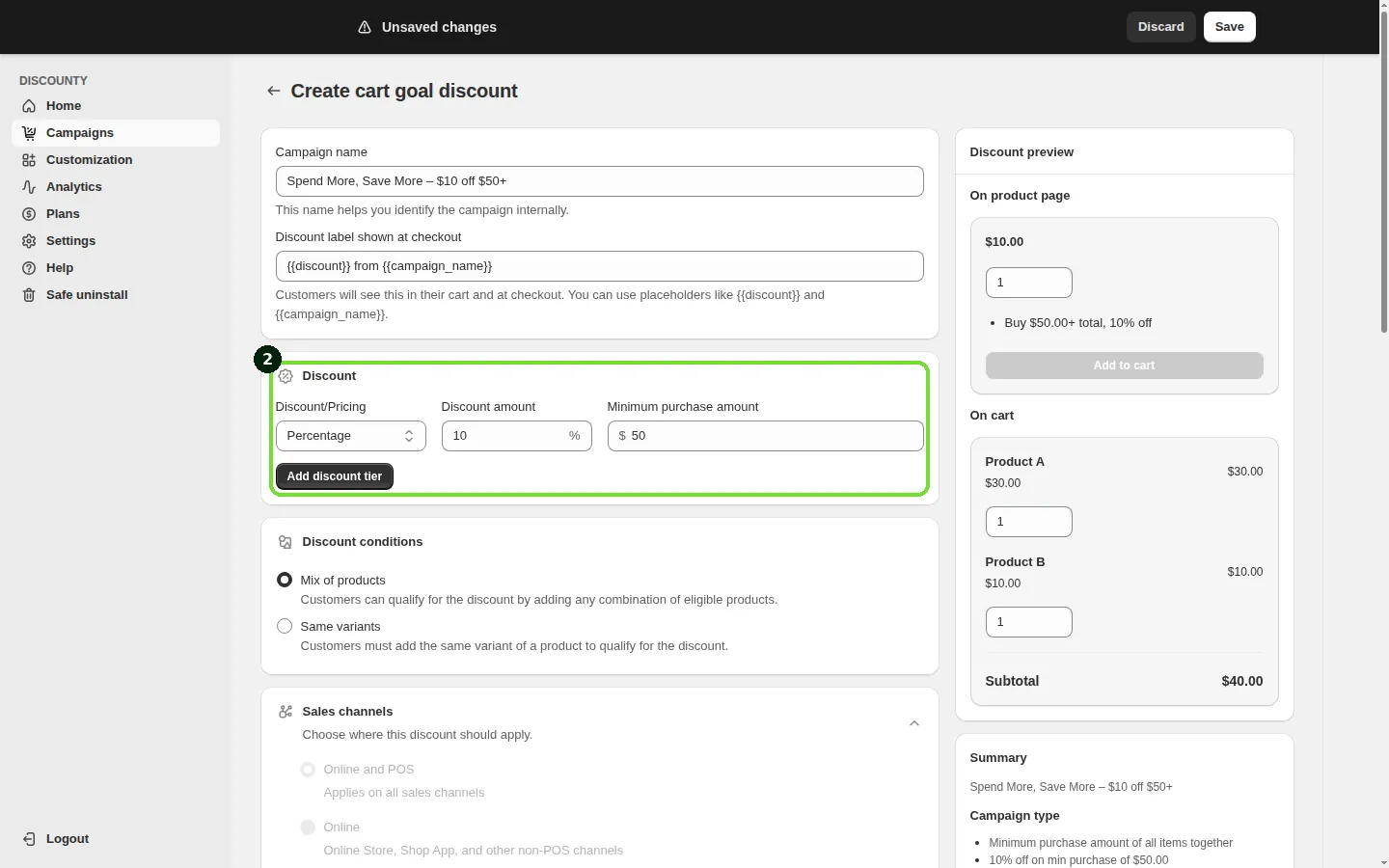
- Choose how the amount is counted. In Discount conditions, pick Mix of products for a classic spend threshold: everything eligible in the cart adds up. Same product, any variant counts each product on its own, and Same variants counts each variant line on its own.
- Choose the products. In the Products card, pick All store, Collections, Product tags, Vendors, Product types or Products and variants. Only these products count toward the amount and get the discount. Anything else in the cart is ignored by this campaign.
- Set the schedule. In the Schedule card, set the start date and time, and an end date if you want one. Dates are read in the time zone of the device you save from, not your store's time zone.
- Check the preview and save. The preview on the right shows the offer on a product page and in a sample cart. Change the sample quantities to confirm the right tier applies. The summary card below it lists your tiers.
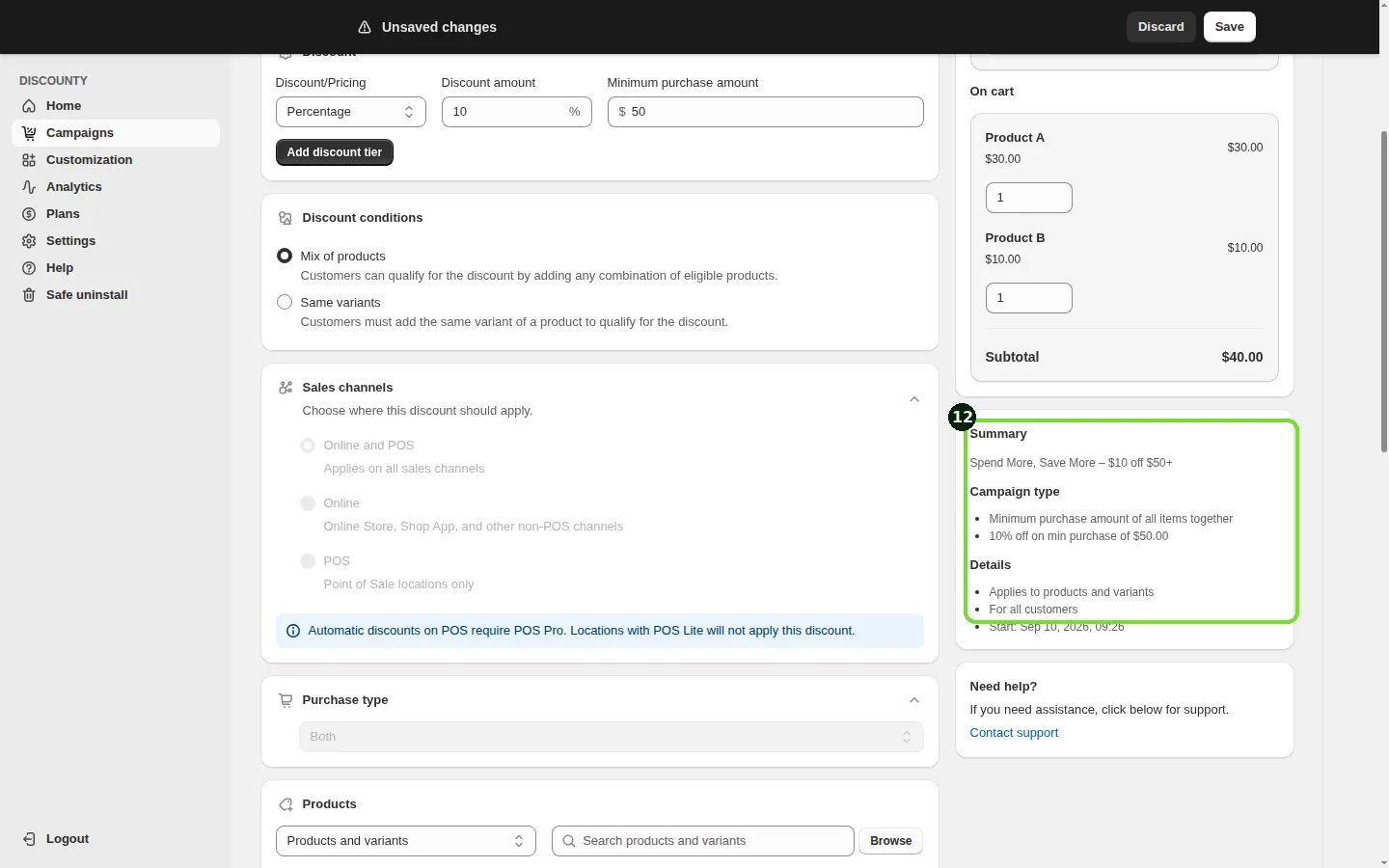
Shoppers who pay in another currency see the thresholds converted to that currency. If the discount does not show up in a test cart, the Cart goal setup guide in our Help Center has a checklist: status Active, products included, lowest tier reached under the chosen conditions, and the right sales channel.
How to undo it
Deactivate the campaign. It shows as Reverting while Discounty removes the discount, and applies no discount during that time. A Cart goal never changes your product prices, so there is nothing to restore on the products.
On an Active campaign you can change only the end date and end time. To change a tier or the products, deactivate it first, edit, then activate it again. For Shopify's own discounts, go to Discounts, click the discount's name, click Deactivate and confirm. With the three-discount setup, do that for each tier.
How do you show shoppers how much more to spend?
Shopify's discount form has no storefront setting, and Discounty's progress bar (the Shipping progress bar) counts toward a shipping reward only, so neither shows a "spend $X more" bar toward a Cart goal tier today. What a Cart goal can show is the tier table and the saving in the cart.
Both are under Customization in Discounty, and both need the Discounty app embed turned on in your theme. Saving on cart has a Display widget on store toggle; the tier table is switched on under Display widget on → Product page.
- The tier table on the product page. The Quantity/Value table lists each threshold and its saving. For a Cart goal, the tiers show amounts in your store currency, such as $100+, instead of quantities. Setup is in the tier table guide.
- The saving in the cart. Saving on cart shows the total before the discount, crossed out, and the amount saved, in the cart page and the cart drawer. See how to turn on Saving on cart.
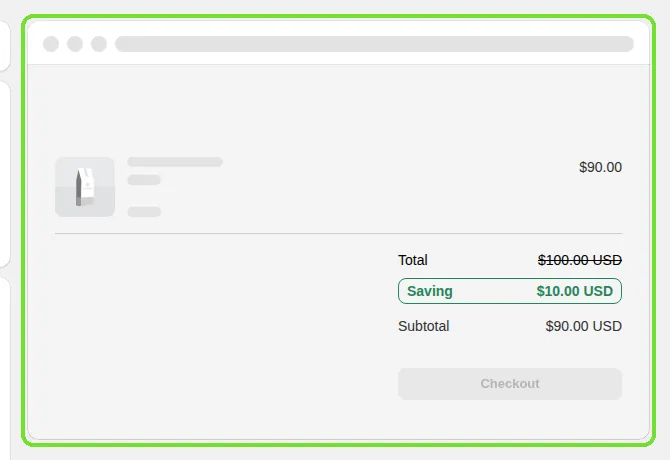
The Shipping progress bar runs only from an automatic Shipping discount campaign. Between the tier table on the product page and the saving line in the cart, a shopper can work out the gap to the next tier.
On the Essential plan and up, a countdown timer can show when the offer ends. It appears on the product page and the home page, not in the cart.
Can you cap the discount on a spend more, save more offer?
Not on a percentage tier. Shopify's amount off form has no maximum discount amount setting; its Maximum discount uses limits how many times a code is used, not how much it takes off. In a Cart goal campaign the highest tier applies with no upper cap: if the top tier is 20% off from $250, a $1,000 cart gets $200 off.
To put a ceiling on the saving, use Fixed amount tiers. A fixed amount is its own cap. In a Cart goal with Mix of products, keep Apply "fixed amount" discount only once per order selected (it is on by default), so the amount comes off once for the whole order. If you clear it, the amount comes off each eligible item instead.
Fixed tiers for our example would be $10 off $100, $20 off $150 and $50 off $250. At each threshold that is 10%, about 13% and 20%. Above it, the share falls as the cart grows. The same works with Shopify's own discounts: choose Fixed amount as the value on each tier.
How much discount should each tier give?
Give each tier no more than your gross margin times the extra spend it asks for, divided by the threshold. For a $50 tier that asks $8 more at 50% margin, that is 8% off. Then set the threshold itself:
- Start from your average order value. If it is $42 and most items cost $12 to $20, a threshold at $50 asks for one more item.
- Set it too low, and you give the saving on orders you would have had anyway.
- Set it too high, and few shoppers reach it.
- Check the margin at the threshold. On a $50 order at 15% off, you give away $7.50. Make sure the extra item pays for it. For free shipping as the reward, see making free shipping profitable.
That ceiling is where the tier breaks even. Above it, the tier costs more than the extra goods earn on that shopper. The broader trade-offs are in how to increase average order value with discounts.
Missing a threshold does not always lose the sale. In two scenario experiments about clothing shopping, Wen-Hsien Huang and Chun-Ming Yang studied shoppers who fell short of a discount (European Journal of Marketing, 2015). The closer their purchase felt to the threshold, the more willing they were to still buy one item at full price. The effect was stronger when the threshold was in dollars, such as "buy $100, get 30% off", than in pieces.
Worked example: does 10%, 15%, 20% pay for a store with an $82 average order?
Take a hypothetical candle store. Its average order is $82, items cost $24 to $48, and its gross margin is 50%, so every extra dollar of goods earns 50 cents before the discount. It plans $100 at 10%, $150 at 15% and $250 at 20%. Here is a shopper who would have spent $82 with no offer:
| Tier reached | Extra spend | Extra margin (50%) | Discount given | Change vs. the $82 order | Break-even discount |
|---|---|---|---|---|---|
| $100 at 10% | $18 | $9.00 | $10.00 | −$1.00 | 9.0% |
| $110 at 10% | $28 | $14.00 | $11.00 | +$3.00 | 12.7% |
| $150 at 15% | $68 | $34.00 | $22.50 | +$11.50 | 22.7% |
| $250 at 20% | $168 | $84.00 | $50.00 | +$34.00 | 33.6% |
The first tier is the weak one. At $100 and 10%, a shopper who stretches from $82 earns the store $1 less than if there had been no offer. Moving that tier to $110 turns it positive, and a $110 cart is still one $28 candle away from $82.
The other cost sits in orders that were already big. A shopper who was going to spend $120 anyway gets $12 off for nothing. Before you launch, count how many of last month's orders already landed between $100 and $149, and multiply by the average saving. That is roughly what the first tier costs you in orders you would have had anyway. The higher tiers carry the same cost, but fewer orders sit there, and the break-even room is wider.
Run the tiers for a few weeks, then compare your average order value and gross margin per order with the weeks before. The arithmetic above tells you what can pay; your orders tell you whether it did.
Can the tiers combine with other discounts?
Some combinations work. A Cart goal can apply on top of a Bulk price editor sale price, if you allow it under Campaign combinations (on the Discounty plan and up, and not with New price). A Cart goal and a Quantity discount cannot combine with each other. To stack a Cart goal with a Buy X get Y or an Advanced discount code campaign on the same item, you need Shopify Plus and the Discounty plan or above. More on what stacks in combining discounts on Shopify.
Questions
What is the difference between a minimum value and a minimum quantity discount?
Minimum value counts money: spend $50, get 15% off. Minimum quantity counts items: buy 3 or more, get 10% off. See what is a quantity discount. Use value when your prices vary a lot, and quantity when items cost about the same.
What does MOV discount mean?
A minimum order value discount: a saving that starts once the order reaches a set amount.
Do shipping and taxes count toward the threshold?
Not on Shopify's own discounts. In a Cart goal campaign, the amount is the total of the eligible products in the cart, item price times quantity.
Does a $500 cart get more than the top tier?
No. The highest tier the cart reaches applies, and it does not grow past that tier. With percentage tiers the dollar saving still grows with the cart; with fixed amount tiers it does not.
Can I limit the offer to some customers?
In a Cart goal campaign, Customer selection can limit the campaign to chosen Shopify customer segments, on the Discounty plan and up.
 How to Put a Whole Shopify Collection on Sale, With the Old Price Crossed Out
 What Is a Tiered Discount? Set Up Tiered Pricing on Shopify
 BOGO on Shopify: What It Is and How to Set It Up