.png)

Why World Cup 2026 Is a Massive Ecommerce Opportunity
Every few years, ecommerce brands get access to a marketing opportunity that is almost impossible to manufacture on their own.
Not because advertising costs suddenly drop.
And not because consumer behavior changes overnight.
Instead, it happens because billions of people around the world become focused on the same event at the same time.
In 2026, that event will be the FIFA World Cup.
For ecommerce brands, moments like these are incredibly valuable. Attention is one of the most competitive resources in modern marketing. Brands spend millions of dollars every year trying to earn it through advertising, content marketing, influencer partnerships, and social media campaigns.
The World Cup delivers it naturally.
For several weeks, consumers actively engage with match schedules, team news, social media conversations, predictions, highlights, and celebrations. Their emotional investment increases, their online activity rises, and their responsiveness to relevant marketing messages becomes significantly stronger.
This is why the FIFA World Cup has historically been much more than a sporting event. It is a global commercial moment that influences consumer behavior across industries ranging from fashion and electronics to food, home goods, beauty, and lifestyle products.
For Shopify merchants, the opportunity is even more compelling.
Unlike traditional retailers that often require months to launch campaigns, ecommerce brands can move quickly. They can create promotions in real time, react to match outcomes, personalize offers, and capitalize on traffic spikes as they happen.
The result is a rare opportunity to increase traffic, improve conversion rates, grow average order value, and acquire new customers during one of the most engaging global events of the decade.
The brands that start preparing now will have a significant advantage when the tournament begins.
Why World Cup 2026 Is Bigger Than Previous Tournaments
Every World Cup attracts massive audiences. However, the 2026 edition introduces several structural changes that make it uniquely valuable for ecommerce brands.
The most obvious difference is scale.
For the first time in the tournament's history, 48 teams will participate instead of 32. While this may appear to be a simple expansion of the competition, the marketing implications are substantial.
More teams mean more countries represented.
More countries mean more fans emotionally invested in the tournament.
And more invested fans create more opportunities for brands to connect with audiences through localized campaigns, relevant messaging, and timely promotions.
The tournament will also feature 104 matches, compared to just 64 in previous formats.
World Cup 2026 will provide 62.5% more match-driven promotional opportunities, 50% more national audiences, and roughly 40% longer engagement time than previous tournaments.
That increase creates dozens of additional marketing opportunities.
Instead of planning around a handful of major matches, ecommerce brands can build entire campaign calendars around different stages of the competition. Group-stage matches, knockout rounds, quarterfinals, semifinals, and the final all become individual promotional opportunities capable of generating traffic and sales.
Perhaps even more importantly, World Cup 2026 will be hosted across the United States, Canada, and Mexico.
For Shopify merchants, particularly those selling to North American consumers, this creates a unique advantage. The tournament will dominate local media coverage, social conversations, and consumer attention for an extended period.
Unlike seasonal events that last only a few days, the World Cup creates momentum that builds over weeks and often begins months before kickoff.
From a marketing perspective, that's exactly what makes it so powerful.
How the World Cup Influences Consumer Spending
One of the biggest mistakes merchants make is assuming that World Cup marketing only works for sports brands.
In reality, the tournament affects purchasing behavior across a surprisingly broad range of categories.
The reason is simple.
Consumers don't just watch the World Cup.
They build experiences around it.
Some purchase new clothing to support their favorite teams. Others invest in televisions, speakers, or entertainment systems to improve their viewing experience. Many organize watch parties with friends and family, creating demand for food, beverages, decorations, furniture, and home accessories.
Even categories that appear unrelated to football can benefit from the emotional energy surrounding the event.
Consider a lifestyle brand selling home décor.
At first glance, there may seem to be little connection between decorative products and the World Cup. Yet consumers preparing their homes for gatherings, celebrations, and viewing parties may be far more receptive to purchasing products that enhance those experiences.
The same principle applies to beauty brands, fashion retailers, food businesses, and consumer electronics companies.
The common denominator isn't the product.
It's the moment.
Major events increase emotional engagement, and emotional engagement often leads to increased spending.
This effect becomes even stronger when merchants align promotions with specific moments during the tournament.
A generic discount may be ignored.
A promotion tied to a dramatic victory, a national celebration, or a high-profile match feels timely and relevant.
Consumers don't simply see an offer.
They experience it as part of the event itself.
That distinction can have a meaningful impact on conversion rates.
Ecommerce Opportunities for Shopify Merchants During World Cup 2026
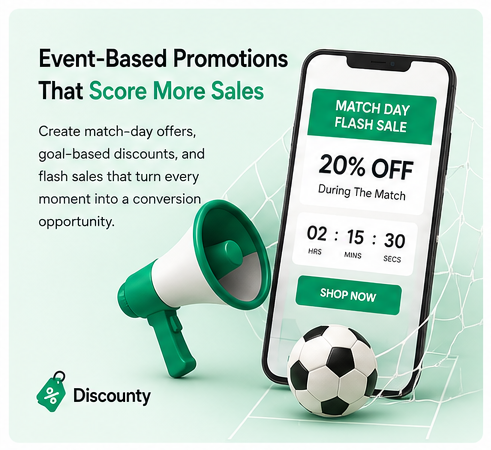
The beauty of event-based ecommerce marketing is that it creates opportunities beyond traditional discounting.
Merchants aren't limited to running a simple percentage-off promotion. Instead, they can build campaigns that evolve alongside the tournament itself.
also read: 15 Shopify Store Promotion Strategies to Increase Sales and Customer Loyalty
One of the most effective strategies is the use of flash sales tied to live events.
Imagine a store launching a two-hour promotion immediately after a national team wins an important match. The offer feels connected to the excitement of the moment, which naturally increases urgency and engagement.
Merchants can also leverage countdown campaigns to build anticipation before kickoff.
Rather than launching a single promotion, brands can create a sequence of offers that gradually increase engagement over several weeks. This approach keeps customers returning to the store while building excitement around both the tournament and the brand.
Bundle promotions become particularly valuable during major events.
Consumers are often willing to spend more when products are grouped around a specific occasion or use case. Instead of promoting individual items, merchants can create curated packages designed around viewing parties, travel experiences, fan celebrations, or seasonal activities associated with the tournament.
Cart-value incentives represent another powerful opportunity.
Rather than offering blanket discounts, merchants can encourage larger purchases through tiered rewards such as:
- Spend $75 and save 10%
- Spend $100 and unlock free shipping
- Spend $150 and receive a bonus gift
These promotions help increase average order value while maintaining healthier profit margins than traditional sitewide discounts.
Most importantly, Shopify merchants can adapt campaigns in real time.
That flexibility is something many larger retailers struggle to achieve.
A merchant can react to a surprise result, a viral moment, or a major victory within minutes, transforming live events into revenue-generating opportunities.
How Shopify Stores Can Prepare for World Cup 2026
The merchants who see the strongest results during major events rarely succeed because of last-minute execution.
They succeed because they prepare early.
By the time the opening match begins, successful brands already have their campaigns planned, assets created, automation configured, and inventory secured.
Preparation should begin with a dedicated promotional calendar.
Rather than viewing the tournament as one large campaign, merchants should break it into distinct phases.
Each stage of the competition creates different opportunities.
Before kickoff, anticipation-driven campaigns can generate awareness and engagement. During the group stage, brands can focus on participation and audience growth. Knockout rounds often create the highest emotional engagement, making them ideal for aggressive promotional activity. The final provides an opportunity for celebration campaigns and post-event sales.
Mapping these moments in advance makes execution significantly easier.
Inventory planning is equally important.
also read: 2025 Shopify holiday retail insight
One of the most frustrating outcomes of a successful campaign is running out of stock when demand peaks.
Brands should identify products likely to benefit from tournament-related demand and evaluate inventory levels well before the competition begins.
Traffic generation also deserves careful attention.
Dedicated landing pages can help merchants capture organic search traffic related to World Cup promotions, tournament-themed collections, and event-driven offers.
Rather than directing all traffic to the homepage, brands can create focused experiences that align with customer expectations and campaign messaging.
Email marketing remains one of the most effective channels throughout major events.
The World Cup provides dozens of opportunities to communicate with customers through:
- Countdown campaigns
- Match-day reminders
- Exclusive offers
- Team-based promotions
- Tournament updates
The goal is not simply to send more emails.
It's to send more relevant emails.
SMS marketing can serve a similar purpose.
Because matches create real-time moments of excitement, SMS is particularly effective for flash sales and short-duration offers. A timely message delivered immediately after a major victory can generate meaningful traffic within minutes.
Why Discount Management Will Be Critical During World Cup 2026
While many brands focus heavily on campaign ideas, far fewer think about operational complexity.
Yet operational execution is often what determines whether a campaign succeeds or fails.
Running one promotion is easy.
Running dozens of promotions simultaneously is much harder.
During the World Cup, merchants may find themselves managing multiple offers across different products, collections, customer segments, countries, and time zones.
A campaign tied to a specific match may need to launch automatically at kickoff and end immediately after the final whistle. Another promotion may activate only if a team wins. A third offer might apply exclusively to selected collections or customer groups.
As promotional complexity increases, manual management quickly becomes unsustainable.
This is where discount management becomes a strategic advantage rather than a simple operational task.
Different promotions often serve different business objectives.
A single discount strategy rarely accomplishes all of those goals.
The most successful merchants combine multiple promotional mechanisms throughout the tournament, including:
- Collection-based discounts
- Volume discounts
- Cart-value incentives
- Free shipping offers
- Bundle promotions
- Loyalty rewards
Managing those campaigns efficiently requires the right infrastructure.
Without it, merchants risk spending more time operating promotions than optimizing them.
How Discounty Helps Shopify Merchants Maximize World Cup Sales
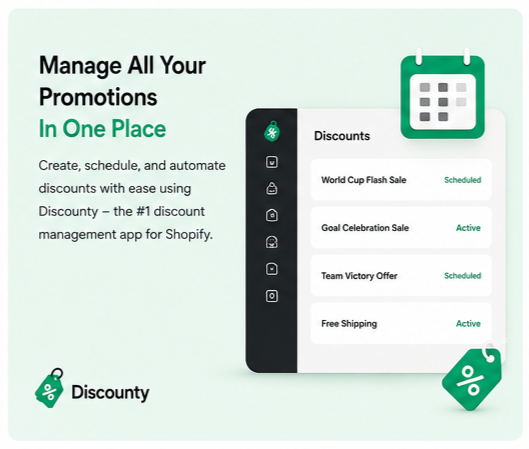
As promotional activity increases, execution becomes just as important as strategy.
This is where the right discount management solution can make a significant difference.
Discounty was built to help Shopify merchants manage exactly this type of promotional environment.
Instead of manually configuring discounts one by one, merchants can create and manage sophisticated campaigns from a centralized system designed specifically for promotional flexibility.
For example, a merchant planning multiple World Cup campaigns can schedule promotions weeks in advance and automatically activate them at specific dates and times.
Discounty's bulk discount management capabilities become especially valuable during large-scale events.
Rather than creating dozens of individual rules manually, merchants can efficiently launch promotions across product collections, categories, and seasonal campaigns.
Collection targeting also enables more strategic promotional execution.
Not every product needs to be discounted equally.
Brands can apply offers to selected collections, featured products, tournament-themed bundles, or inventory categories that align with specific campaign goals.
For merchants focused on increasing average order value, advanced discount structures can encourage larger purchases while protecting margins.
Instead of relying exclusively on sitewide discounts, brands can build promotions that reward customers for purchasing more, spending more, or engaging more deeply with the store.
Most importantly, Discounty helps merchants remain agile.
World Cup marketing is dynamic.
A campaign idea that doesn't exist today may become one of the biggest opportunities tomorrow because of a dramatic match result, a viral moment, or a surge in customer interest.
Merchants need tools that allow them to move quickly.
Discounty provides that flexibility while reducing the operational burden associated with managing multiple promotions at scale.
Conclusion
World Cup 2026 is shaping up to be one of the most significant ecommerce opportunities of the decade.
The tournament's expanded format, increased number of matches, larger global audience, and extended engagement period create a unique environment for customer acquisition and revenue growth.
For Shopify merchants, the opportunity extends far beyond sports-related products.
Any brand capable of connecting its marketing efforts to the excitement, emotion, and attention surrounding the tournament can benefit from increased engagement and stronger purchasing intent.
However, success won't happen automatically.
The brands that win during World Cup 2026 will be the ones that prepare early, build strategic campaigns, and create promotional experiences that feel relevant to the event.
They will understand that effective World Cup marketing isn't simply about offering discounts.
It's about delivering the right offer at the right moment.
As competition for consumer attention increases throughout the tournament, promotional execution will become a key differentiator.
That's why investing in the right discount management infrastructure today can create a meaningful advantage when the tournament begins.
For Shopify merchants looking to maximize revenue during World Cup 2026, Discounty provides the flexibility, automation, and control needed to launch impactful promotional campaigns at scale and turn one of the world's biggest sporting events into one of the year's biggest growth opportunities.
Frequently Asked Questions
What is the World Cup 2026 ecommerce opportunity?
World Cup 2026 represents a major opportunity for ecommerce brands to increase traffic, conversions, and customer acquisition by leveraging the heightened consumer engagement surrounding the tournament through targeted promotions and event-driven marketing campaigns.
How can Shopify merchants benefit from World Cup marketing?
Shopify merchants can capitalize on increased consumer attention by running match-day promotions, flash sales, themed campaigns, referral programs, bundle offers, and limited-time discounts aligned with tournament moments.
What are the best World Cup discount campaign ideas?
Some of the most effective strategies include goal-based promotions, victory discounts, countdown campaigns, flash sales during live matches, free shipping offers, bundle discounts, and cart-value incentives.
When should ecommerce brands start preparing for World Cup 2026?
Ideally, brands should begin planning several months before the tournament starts. Early preparation allows time for inventory forecasting, campaign creation, landing page development, email automation, and promotional scheduling.
Why is event-based ecommerce marketing effective?
Event-based marketing works because it aligns promotional messaging with moments that consumers already care about. This increases relevance, engagement, and the likelihood of conversion compared to generic promotional campaigns.
How can Discounty help with World Cup promotions?
Discounty helps Shopify merchants automate, schedule, manage, and optimize promotional campaigns through advanced discount management features, making it easier to execute complex World Cup marketing strategies efficiently.