
We’ve all been there. You launch a 20% off weekend sale, and the Shopify "ka-ching" notification sound feels like a victory march. But then, a week later, you're looking at your profit-and-loss sheet, and... ouch. After product costs, shipping, and ad spend, that "victory" feels a lot more like a tie. Or maybe even a loss.
If that sounds familiar, you're in the right place.
Discounts are effective instruments for store owners, yet they may be dangerous. They may undermine profit margins and train customers to never pay full price when used carelessly. This guide isn't here to tell you to stop offering discounts. It's here to show you what balancing discounts truly means; how to use them strategically to boost sales, attract new customers, and actually protect your profitability.
The Double-Edged Sword of Discounts: Why Balance is Everything
It’s dangerously easy to fall into the "discount trap." It starts with a simple welcome offer, then a holiday sale, then an end-of-season sale, and suddenly you've got a permanent "SALE" collection on your site that customers expect.
The "Discount Trap": When "More Sales" Actually Means "Less Profit"
Here’s the hard truth: a 10% discount does not equal a 10% dip in profit. It's much, much worse.
Consider it: The profit margin is the one that is left after covering all the expenses. To illustrate, when you are selling a product at a price of 100 dollars:
- A 10% discount ($10 off) cuts your profit from $40 to $30. That's a 25% loss in profit!
- A 20% discount ($20 off) cuts your profit from $40 to $20. You've just lost half your profit on that sale.
You would have to sell twice as many units to break even to compensate for a 20% discount. That's a huge mountain to climb. So what is the right discount level?
This trap has two other nasty side effects:
- Brand Erosion: You accidentally teach your best customers that your products aren't worth full price, so they just wait for the next sale.
- Attracting the "Wrong" Customer: You might get a lot of first-time buyers, but they're often price-sensitive "deal hunters" who have zero loyalty and won't buy from you at full price.
So, What is Balancing Discounts?
This brings us to the core of the issue. Balancing discounts is the sweet spot.
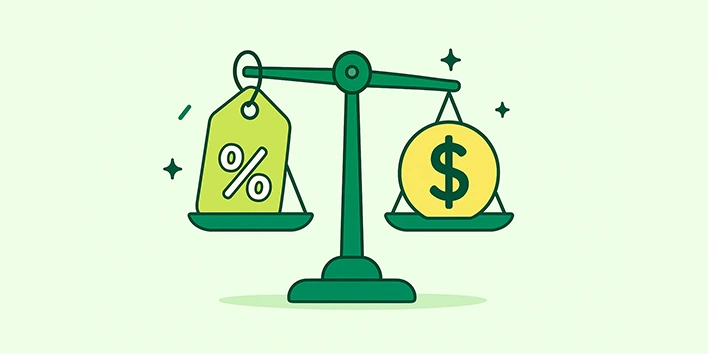
It’s the strategic process of using promotions to achieve a specific goal (like acquiring a customer or increasing cart size) while protecting your net profit and long-term brand value.
An unbalanced discount asks: "How can I make a sale?"
A balanced discount approach poses the question: How can I sell profitably today and get the customer to come back?
The Psychology of a Good Deal: Why Discounts Work (A Little Too Well)
The first step to balancing discounts is to know why they are so effective. It is all about human psychology.
Perceived Value vs. Actual Value (Anchoring)
Customers are not always aware of the actual price of a product; they seek hints. The original price is the best indication. When you display a price as $200 $160, you're "anchoring" their perception. The $200 anchor will make the $160 look like a bargain. The $40 in savings feels like a tangible gain.
Interestingly, the format of the discount matters.
- For high-priced items (over $100), "20% off" often feels bigger and more significant than "$40 off."
- For low-priced items (under $100), a "$10 off" discount feels more concrete and valuable than "33% off."
The Power of "Free" and FOMO
Our brains are wired to love the word "free."
This is why Buy One, Get One Free (BOGO) promotions are very effective. Actually, 66 percent of consumers indicate that they like BOGO more than other discounts.
Why? Although a BOGO is 50% off on two products, our brain will interpret it differently: you purchase one product at its full price and receive a second one for free. That is nearly impossible to resist.
This feeling of urgency, coupled with FOMO due to a flash sale, makes customers purchase immediately before the offer expires.
How Much is Too Much? Finding Your Discounting Sweet Spot
So, what's the magic number? 10%? 25%?
Here's the secret: there isn't one. The right discount is not an estimate; it is a calculation. You should be aware of what you are losing before you give a discount.
Read More: Percentage vs Fixed Amount Discount
Start With Your Break-Even Point (The Non-Negotiable Math)
- Your first step is to ignore the sale price and look at your profit margin.
- Let’s say you sell a product with a 40% profit margin. If you offer a 10% discount, it doesn't just reduce your profit by 10%. It reduces that 40% margin down to 30%. You've actually lost 25% of your profit.
- A 20% discount on that same item requires you to double your sales just to make the same amount of profit.
- Before any promotion, you must know your break-even point. This isn't just about covering the cost of the product; it's about knowing how many more units you need to sell to make the discount worth it.
Want the full formulas? For a deep dive into the math and how to calculate your break-even point on a discount, check out our full guide: The most effective discount percentage.
The Strategic Discount Type: A Rapid Guide to Choosing Your Weapon
Discounts are not made equal. Select a discount that is equal to your objective. The following is a brief summary of objectives and corresponding discounts:
Goal: New Customer Acquisition
Best Tools: Welcome discounts (10-15% off) or a free gift with the first purchase. This welcomes customers without initiating a price war.
Goal: Growing Average Order Value (AOV)
Best Tools: Tiered Discounts ("Buy more, save more") or Minimum Purchase thresholds ("$20 off orders over $100"). They are excellent at pushing customers to buy one more product.
Read More: Increase AOV With Discount
Goal: Clearing Old Inventory
Best Tools: Buy-One-Get-One (BOGO) or bundle deals. These feel like a huge win for the customer and help you move stock without just slashing prices by 50%.Read More:
Read More: What is BOGO discount?
Goal: Building Customer Loyalty
Best Tools: Early access to sales, exclusive VIP offers, or loyalty points. These build an emotional connection that goes beyond a simple transaction.
Want the full playbook? There are many other strategies, from bundling to free shipping. To see the pros and cons of each, read our complete guide: Types of Discount in Marketing.
Balancing Discounts and Profitability: How to Protect Your Margins
This is the very heart of a balanced discount strategy. A promotion is only "successful" if it's profitable. A spike in sales that results in a net loss isn't a win; it's just busy work.
Setting "Guardrails" for Your Promotions
Your profit margins need protection. Think of these as the rules that keep your business safe.
- Exclude Your Premium Products: Your bestsellers or luxury items should rarely, if ever, be part of a general sale. Discounting them can damage their perceived value. Let them be the full-price items that customers are happy to pay for.
- Use Minimum Spend Thresholds: Never offer "15% off" with no strings attached. Always tie it to a minimum purchase (e.g., "15% off orders over $75"). This protects you from low-value, low-profit orders and helps increase your average order value.
- Limit Redemption: Use single-use codes, set expiration dates, and limit the number of times a discount can be used. This generates a sense of urgency and prevents the offer from being posted on coupon sites for months.
Making Smart Decisions with Data
The trick to discounting and profitability is to allow the data, rather than gut feelings, to drive your decisions.
That is where a special tool can come to the rescue. As a Shopify owner, you can rely on Discounty to create and automate guardrails (no need for calculators or spreadsheets). Instead of just creating a simple code, you can build complex, tiered rules like "Buy 2, Get 10% Off" or "Spend $100, Get $20 Off" that automatically protect your margins. It also examines sales data in such a way that you can optimize promotions rather than making guesses.
The goal is to move from "I hope this works" to "I know this works."
Read More: What is volume discount?
Beyond the First Sale: Balancing Discounts and Customer Lifetime Value (CLV)
A truly balanced discount strategy thinks long-term. The ultimate goal isn't just to make one sale; it's to acquire a customer who will (hopefully) buy from you again and again.
This is the entire game of Balancing Discounts and Customer Lifetime Value (CLV). A cheap sale today is a failure if it kills the chance of a full-price sale tomorrow.
Are You "Buying" Customers Who Will Never Return?
It's tempting to offer a huge 40% off coupon for a customer's first purchase. You'll get a lot of signups! But what have you really done?
You've just taught that new customer that your product is only worth the deeply discounted price. You've attracted a "deal hunter," not a loyal fan. This person is loyal to the discount, not to your brand. They will almost certainly not return to buy at full price, meaning you spent a ton of money (in lost margin) to acquire a customer with a CLV of near-zero.
That's not a win. It's just an expensive mistake.
Research from Optimove found that modest welcome discounts (in the 5-20% range) are great for building long-term loyalty.
But offering more than 20% off didn't make customers any more loyal or spend more over their lifetime. The extra discount was just pure, wasted profit.
Balancing Fees and Discounts with Loyalty
So, how do you reward your best, most loyal customers?
You shift your focus from discounts to value.
A constant 20% off coupon builds a transactional relationship. A loyalty program builds an emotional one. Instead of just giving away margin with another sale, try these value-based rewards:
- Loyalty Points: This is a classic for a reason. Customers earn points on full-price purchases that they can redeem for a discount or free product later. It's a psychological "hook" that encourages the next purchase.
- Exclusive Early Access: Let your VIPs shop new arrivals or seasonal sales 24 hours before anyone else. This costs you absolutely nothing but makes them feel special and valued.
- Free Gift with Purchase: A high-value sample or a free accessory can be perceived as more valuable to the customer, but it costs you less than a 15% discount.
This is the most balanced approach to fees and discounts: you are rewarding the behavior you want, which is loyalty, and not just anyone who walks in.
Balancing Discounts in Action: 3 Real-World Scenarios
Let's make this all concrete. The following is the appearance of an unbalanced and a balanced discount strategy.
Scenario 1: The New Skincare Brand (Goal: Acquisition)
- Unbalanced: a pop-up with a 40% discount on the first order.
- Outcome: A large number of one-time buyers, low profit margins, and a new customer base that now believes that your $50 serum is only worth $30.
- Balanced: a pop-up with either 15% off the first order or a Free mini face oil with the first purchase of over 50.
- Outcome: You get customers who pay close to full price. The free-gift option safeguards the margin and increases AOV, and allows them to sample a second product.
Scenario 2: The Established Fashion Store (Goal: Increase AOV)
- Unbalanced: a 25% store-wide flash sale.
- Outcome: Sales will be flooded, but the majority of customers will purchase only the product they were already intending to purchase. Now you just make 25% less profit on it.
- Balanced: A tiered discount: "Spend $100, save 10%... Spend $150, save 20%!"
- Outcome: This is brilliant. A customer who has a cart of 100 will be highly encouraged to purchase an extra item to get to the next level, which will push AOV up.
Scenario 3: The Coffee Roaster (Goal: Clear Old Inventory)
- Unbalanced: 50 percent off clearance sale on Last Month's Roasts.
- Outcome: The stock is sold quickly, but the offer is an indication that the coffee is stale and undesirable. That is a blow to the freshness of your brand.
- Balanced: A package offer: “Purchase one new-arrival roast, and receive one of the previous month's roasts at 75% off.
- Outcome: You still move the old inventory, but you've anchored it to a full-price sale of your new product. Both products maintain high perceived value, and it is a traditional, intelligent bundling approach.
Your Next Move: Random Sales to a Smart Discount Strategy
Discount balancing is not about being cheap with coupons. It’s about strategy. The objective is to prevent the act of giving away profit without any reason and to leverage discounts to create a healthier and more profitable business.
Your next step? Don't just launch another 20% off sale. First, go calculate your profit margins. Then, pick one goal (like increasing your AOV) and build one smart, balanced discount (like a "spend $100, save 15%") to achieve it.
Frequently Asked Questions
1. How often should I offer discounts?
Less is more. Target major shopping events such as Black Friday or end-of-season and specific, goal-oriented promotions.
2. Will discounting devalue my brand?
It absolutely can if you do it too often, too steeply, or on your premium, flagship products. Strategic, rare discounts (like for a loyalty club) can build excitement. Constant, store-wide discounts build the expectation of cheapness.
3. What's a bigger mistake: discounting too much or not enough?
Discounting too much, without a doubt. It's very easy to add a discount or run a sale later if things are slow. It is extremely difficult to raise your prices or take a discount away after you've positioned yourself as a discount brand. You can't un-ring that bell.