
Black Friday Discount Percentage: What Stores Actually Run
Marketing and Discount

Black Friday Discount Percentage: What Stores Actually Run

Mahbod Mortazavi, Marketing Director at Discounty
Mahbod Mortazavi
|
October 13, 2026

In short

  • The median Black Friday discount last year was 20%, the same as an ordinary week in September.
  • 64% of campaigns were under 30%. Only 12% reached 50%.
  • What changes for Black Friday is the floor, not the ceiling: the bottom quarter comes up from 12% to 15%.

The typical Black Friday discount on Shopify stores is 20%. That was the median across the percentage campaigns Shopify stores opened in Discounty during Black Friday week last year, and only 12% reached 50%.

You are deciding what to put on the banner, and plenty of advice says Black Friday means half off. It is worth knowing what stores actually did.

That median is the same as an ordinary week in September. The deep-discount version of Black Friday is real, but it is a minority of the shops running one.

A median tells you where the middle of the market sat. Your margin decides what you can carry.

What stores actually ran

Sorting those campaigns by size gives a shape that looks nothing like the advice.

DiscountShare of campaigns
Under 10%8%
10-19%23%
20-29%33%
30-39%16%
40-49%8%
50% or more12%

64% of Black Friday campaigns were under 30%. Only 12% reached the 50% that most Black Friday advice treats as the starting point.
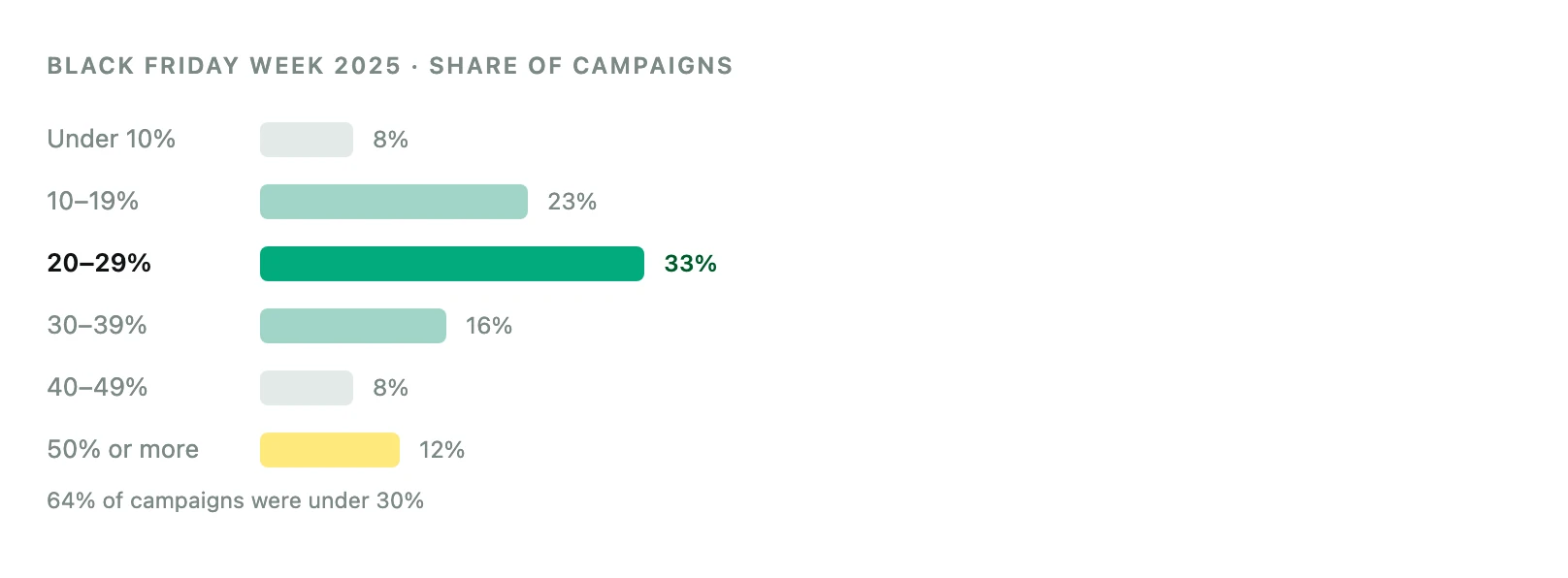
Black Friday discounts by depth. Most sat between 10 and 29%, and 12% went to 50% or more.

Why the number moves less than you would expect

Between the quiet months and Black Friday week, the middle of the market barely shifts. What changes is the bottom: the quarter of campaigns that would have been 12% in September come in at 15%. Stores tighten the floor rather than raising the ceiling.

That makes sense once you separate two things a discount can be for. A Black Friday sale is competing for a shopper who is already buying that week, so the discount has to be visible, not enormous. A clearance is competing with the cost of holding stock, and that is where the deep numbers live, in January rather than November.

Deciding your own number

Three questions get you closer than any benchmark.

What is the discount for? Clearing a specific line, bringing back customers who have not ordered in a year, and being findable during the busiest week are three different jobs. Only the first is helped by going deep.

What does your margin carry? A 40% discount on a 50% margin leaves almost nothing per unit, so the campaign has to sell far more to be worth running. Work out how many extra units the discount needs before it makes money, and ask whether that number is plausible.

What did you do last year? Your own repeat customers remember. A store that ran 30% last November and 15% this one has a harder message than a store that has always run 20%.

What matters more than the percentage

Once the number is inside a range your margin allows, the things that change the result are not the number.

Whether it is visible. A discount nobody sees is not a discount. Price changes written into the product show everywhere the product shows: the storefront, Google Shopping, the catalogue an AI assistant reads.

Whether it combines. Decide before the week whether the site-wide percentage may stack with a shipping threshold or an email code. Carts getting more than you intended is the most common Black Friday accident.

Whether it ends. A campaign scheduled to close on a date, with the prices returning by themselves, is one you can write a deadline about. A sale that drifts on into December teaches people to wait.

Whether it works on a phone. Check the offer, the badge and the checkout on a phone before the week, as well as on a laptop. StoreLab's Mobile Experience checklist covers what to look at.

Don't forget to stress-test your consent setup

Your storefront is not the only thing that needs testing before BFCM. This is also when merchants are launching new campaigns, adding tracking pixels, changing landing pages, and relying heavily on analytics and advertising data.

Before the traffic spike, check that your cookie banner appears correctly in the regions you sell in and that analytics and marketing trackers behave as expected when visitors Accept, Reject, or change their Preferences.

A Shopify privacy app like Consentmo can help with this. You can scan your store for trackers, review your compliance setup, and test how consent affects what runs on your storefront. It is a simple check to make before BFCM campaigns go live, and a much easier problem to fix before thousands of shoppers arrive. Consentmo is an app we work with as a partner.

How we counted

The depths are counted across every percentage campaign that Shopify stores opened in Discounty during Black Friday week, 24 November to 1 December 2025, read from our own records in September 2026. Every figure is a share or a median across stores. No single store can be identified from it.

Questions

What is the average Black Friday discount?

Across the percentage campaigns opened during Black Friday week 2025 on Shopify stores using Discounty, the median was 20% and the mean was about 25%. 64% were under 30%.

Should I discount 50% on Black Friday?

Only 12% of Black Friday percentage campaigns did. A cut that deep needs a reason beyond the date, such as stock you are paying to hold or a product whose margin can absorb it.

Is a bigger Black Friday discount always better?

No. A deeper cut sells more units and keeps less of each. The number worth watching is what the campaign returned after the discount, not what it sold.

When should a Black Friday discount start and end?

Give it both dates when you create it, and say them. A campaign that continues afterwards teaches customers to wait for the next one instead of buying in the week.

Black Friday Discount Percentage: What Stores Actually Run

Mahbod Mortazavi, Marketing Director at Discounty
Mahbod Mortazavi
|
October 13, 2026
Black Friday Discount Percentage: What Stores Actually Run
Marketing and Discount

In short

  • The median Black Friday discount last year was 20%, the same as an ordinary week in September.
  • 64% of campaigns were under 30%. Only 12% reached 50%.
  • What changes for Black Friday is the floor, not the ceiling: the bottom quarter comes up from 12% to 15%.

The typical Black Friday discount on Shopify stores is 20%. That was the median across the percentage campaigns Shopify stores opened in Discounty during Black Friday week last year, and only 12% reached 50%.

You are deciding what to put on the banner, and plenty of advice says Black Friday means half off. It is worth knowing what stores actually did.

That median is the same as an ordinary week in September. The deep-discount version of Black Friday is real, but it is a minority of the shops running one.

A median tells you where the middle of the market sat. Your margin decides what you can carry.

What stores actually ran

Sorting those campaigns by size gives a shape that looks nothing like the advice.

DiscountShare of campaigns
Under 10%8%
10-19%23%
20-29%33%
30-39%16%
40-49%8%
50% or more12%

64% of Black Friday campaigns were under 30%. Only 12% reached the 50% that most Black Friday advice treats as the starting point.

Black Friday discounts by depth. Most sat between 10 and 29%, and 12% went to 50% or more.

Why the number moves less than you would expect

Between the quiet months and Black Friday week, the middle of the market barely shifts. What changes is the bottom: the quarter of campaigns that would have been 12% in September come in at 15%. Stores tighten the floor rather than raising the ceiling.

That makes sense once you separate two things a discount can be for. A Black Friday sale is competing for a shopper who is already buying that week, so the discount has to be visible, not enormous. A clearance is competing with the cost of holding stock, and that is where the deep numbers live, in January rather than November.

Deciding your own number

Three questions get you closer than any benchmark.

What is the discount for? Clearing a specific line, bringing back customers who have not ordered in a year, and being findable during the busiest week are three different jobs. Only the first is helped by going deep.

What does your margin carry? A 40% discount on a 50% margin leaves almost nothing per unit, so the campaign has to sell far more to be worth running. Work out how many extra units the discount needs before it makes money, and ask whether that number is plausible.

What did you do last year? Your own repeat customers remember. A store that ran 30% last November and 15% this one has a harder message than a store that has always run 20%.

What matters more than the percentage

Once the number is inside a range your margin allows, the things that change the result are not the number.

Whether it is visible. A discount nobody sees is not a discount. Price changes written into the product show everywhere the product shows: the storefront, Google Shopping, the catalogue an AI assistant reads.

Whether it combines. Decide before the week whether the site-wide percentage may stack with a shipping threshold or an email code. Carts getting more than you intended is the most common Black Friday accident.

Whether it ends. A campaign scheduled to close on a date, with the prices returning by themselves, is one you can write a deadline about. A sale that drifts on into December teaches people to wait.

Whether it works on a phone. Check the offer, the badge and the checkout on a phone before the week, as well as on a laptop. StoreLab's Mobile Experience checklist covers what to look at.

Don't forget to stress-test your consent setup

Your storefront is not the only thing that needs testing before BFCM. This is also when merchants are launching new campaigns, adding tracking pixels, changing landing pages, and relying heavily on analytics and advertising data.

Before the traffic spike, check that your cookie banner appears correctly in the regions you sell in and that analytics and marketing trackers behave as expected when visitors Accept, Reject, or change their Preferences.

A Shopify privacy app like Consentmo can help with this. You can scan your store for trackers, review your compliance setup, and test how consent affects what runs on your storefront. It is a simple check to make before BFCM campaigns go live, and a much easier problem to fix before thousands of shoppers arrive. Consentmo is an app we work with as a partner.

How we counted

The depths are counted across every percentage campaign that Shopify stores opened in Discounty during Black Friday week, 24 November to 1 December 2025, read from our own records in September 2026. Every figure is a share or a median across stores. No single store can be identified from it.

Questions

What is the average Black Friday discount?

Across the percentage campaigns opened during Black Friday week 2025 on Shopify stores using Discounty, the median was 20% and the mean was about 25%. 64% were under 30%.

Should I discount 50% on Black Friday?

Only 12% of Black Friday percentage campaigns did. A cut that deep needs a reason beyond the date, such as stock you are paying to hold or a product whose margin can absorb it.

Is a bigger Black Friday discount always better?

No. A deeper cut sells more units and keeps less of each. The number worth watching is what the campaign returned after the discount, not what it sold.

When should a Black Friday discount start and end?

Give it both dates when you create it, and say them. A campaign that continues afterwards teaches customers to wait for the next one instead of buying in the week.