
In short
- Treat Cyber Monday as the last day of the Black Friday offer, at the same depth. A deeper Monday price tells Friday's buyers they lost.
- Put an "Ends in" countdown on the sale, and let it end at 23:59 as it says.
- For Monday news, add one thing that keeps the price: free shipping above your average order, a gift over a threshold, or a category that sat out.
Cyber Monday 2026 is Monday 30 November, the fifth day of a sale many stores open on Thanksgiving. By Monday your list has heard the offer several times, and the pull to announce something bigger is strong. This guide takes the other side. Make Monday the last day of the same offer, say so with a countdown, and if you want news, add something that keeps the price.
The examples use one clothing store. It runs 20% off most of its range from Thursday to Monday. Its average order is $72 at sale prices, and shipping an order costs it $8. Pick one addition for Monday from this table, then use its section below.
| Your store | Monday's addition | Campaign type |
|---|---|---|
| Charges shipping below a minimum | Free shipping above your average order | Shipping discount |
| Already ships free above a minimum all year | A gift over a threshold | Buy X get Y |
| Sells electronics, or held a range back | A category that sat out the weekend | Bulk price editor |
| Sells many products, in carts of several items | A step by cart value | Cart goal |
Why is Cyber Monday the last day, never a deeper one?
Why it matters. A customer who bought on Friday and sees a lower price on Monday learns that Friday's price was not the real one. Eric Anderson and Duncan Simester ran a 28-month field test with more than 50,000 customers of a US catalogue retailer. Those who saw an item cheaper after buying it ordered about 15% less afterwards (Quarterly Journal of Economics, 2010). The drop was largest among the customers who spent the most. Depth is also a weak way to stand out. Last Black Friday week, the median percentage campaign in Discounty was 20%, the same as an ordinary week. And for most categories, Adobe's 2026 forecast puts the deepest prices of the season on Black Friday itself. Electronics and computers are the exception, and they peak on Monday.
- Write the core offer down once: its depth, its products, and its dates from Thursday 26 November, 00:00, to Monday 30 November, 23:59.
- Build it as one Bulk price editor campaign across the whole window, so the price cannot drift between days.
- Keep Monday's depth equal to Friday's on every product that was in the sale.
- Build any Monday addition as a separate campaign, with Monday's start and end.
- Pick one addition. Two is already a lot to explain in one email.
Worked example. A $100 jacket sells at $80 on Friday, at 20% off. If Monday takes it to 30%, it sells at $70. Every Friday buyer of that jacket lost $10 for being early, and next November they wait. Keep it at $80 and add free shipping above $80, and nobody sees the jacket cheaper than they bought it.
The catch. If you sell electronics or accessories, Monday is when Adobe expects that category to be cut deepest. Give Monday a category that sat out the weekend, at the weekend's depth, and leave Friday's products where they were.
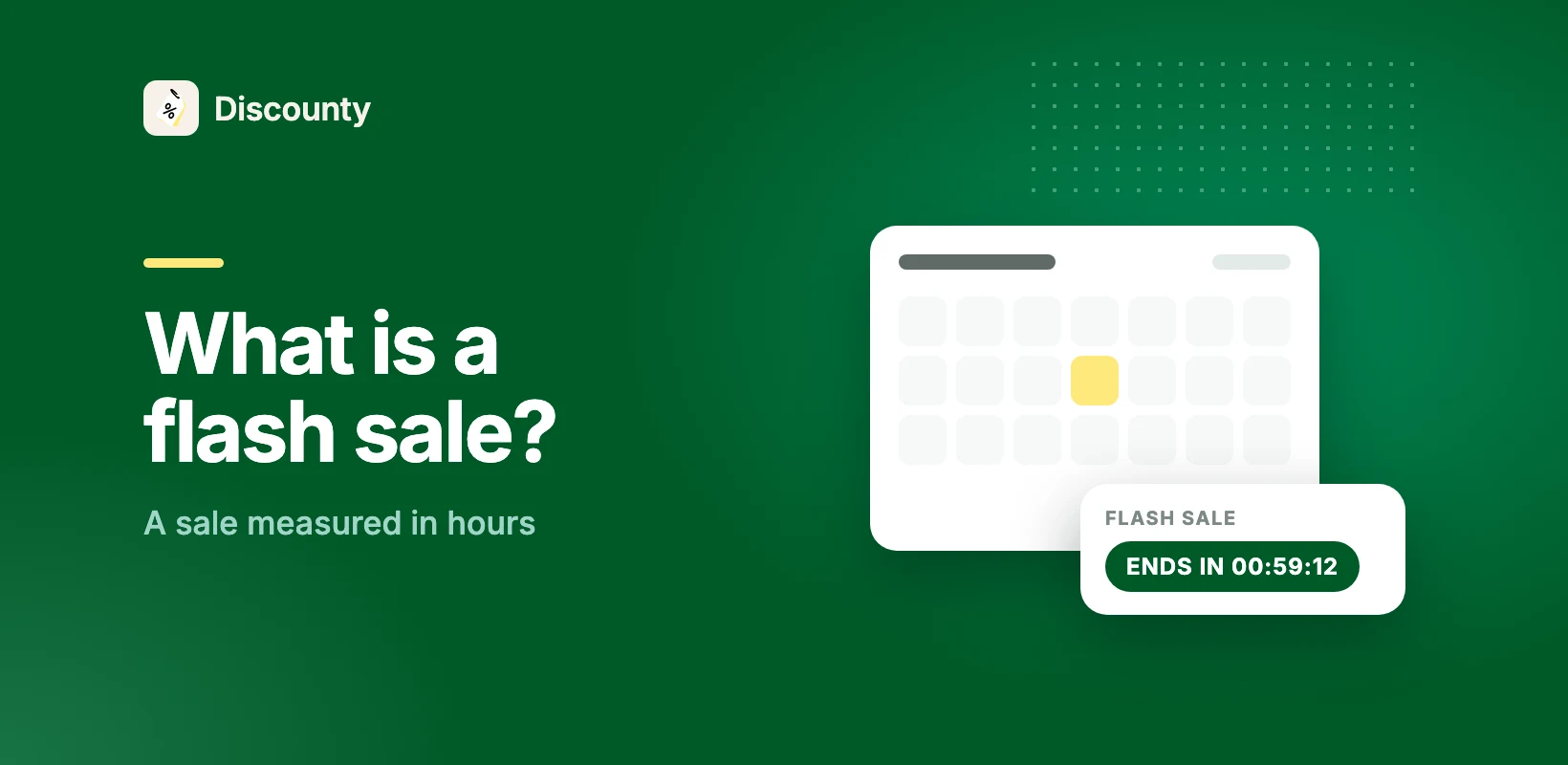
Put an "Ends in" countdown on the last day
Why it matters. A deadline is Monday's news, and it works when it is true. Inman and McAlister found that use of dated offers rises just before they expire (Journal of Marketing Research, 1994), which makes the last hours count. US and UK regulators treat a countdown that restarts, or an offer that continues after zero, as false urgency. Last Black Friday season, 16% of the campaigns stores started in Discounty showed an end countdown, so most sales ended without one.
- Open the weekend's Bulk price editor campaign and check its end: Monday 30 November, 23:59.
- Turn on Activate countdown timer.
- In the Countdown section, choose Ends in and keep the campaign end date.
- Go to Customization, then Countdown Timer, choose the Ends in timer, and switch on its display in the store.
- Write the title, for example "Black Friday ends in".
- Open a sale product on a phone and check the timer and the price.
The countdown timer is on the Essential plan and up.
Worked example. Your store runs on New York time, and the sale ends at 23:59 Eastern. At 08:00 Eastern the timer shows 15 hours and 59 minutes. A shopper in Los Angeles opens the store at 18:00 their time, which is 21:00 Eastern. Their timer shows 2 hours and 59 minutes, and the sale ends at 20:59 where they are.
The catch. The timer is a promise about what happens at zero. If prices are still down on Tuesday morning, you broke it in front of every shopper who saw it. Also, one homepage timer runs at a time. Turning one on in another campaign switches off the one before.
Free shipping above your average order
Why it matters. In Baymard Institute's research, extra costs such as shipping are the reason shoppers give most often for leaving a checkout. A price of exactly zero also pulls harder than the money it saves. Free shipping on every order, though, raised sales and cut profit in Lewis, Singh and Fay's study of an online retailer (Marketing Science, 2006), and pushed returns up in Shehu, Papies and Neslin's (2020). A minimum above the average order earned more than free shipping for all in Chen and Ngwe's study of more than two million Zalora orders (2018), because small orders grew to reach it. No minimum makes sense when shipping costs under about a tenth of your average order, or is already in your prices.
Shipping discount is on the Lite plan and up. The shipping progress bar works on automatic shipping discounts, on one campaign at a time.
- Create a campaign and choose Shipping discount.
- Choose Automatic Discount, so nothing has to be typed.
- Set the discount to Free shipping.
- Choose Minimum order amount and set it where the extra spend pays the shipping: your average order plus your shipping cost divided by your margin.
- Choose the markets it covers.
- Turn on the progress bar for this campaign, so the cart shows what is left to spend.
- Set the start to Monday 00:00 and the end to Monday 23:59.
Worked example. Shipping costs the store $8, which is 11% of its $72 average order. With no minimum, a $25 order carries the same $8, close to a third of the sale. At a 60% margin, $72 plus $8 divided by 0.60 is about $85, so set the minimum at $90. A shopper at $72 adds an $18 scarf to reach $90. The scarf earns $10.80 and covers the delivery.
The catch. Shopify applies one shipping discount per order. If the weekend already had free shipping, Monday's is no news. If your store ships free above a minimum all year, it is no news either, so use a gift over a threshold instead.
A gift over a threshold, when shipping is already free
Why it matters. A gift leaves the price of what the shopper came for untouched, so your reference price stays where it is. Its cost is what the gift costs you, which is less than its shelf price. Things given free lose some of their value in the shopper's eyes, and showing the gift's price limits that. So pick something you also sell. In Attentive's June 2026 survey of 600 shoppers, a gift with purchase came second among reasons to buy beyond a discount (42%), after free shipping (68%).
Buy X get Y is on the Lite plan and up. Auto-add to cart and Show Pop-up need the Discounty app embed turned on in your theme.
- Create a campaign and choose Buy X get Y.
- Under Customer buys (X), choose the sale collection.
- Under Discount condition, choose Minimum spend amount, and set Minimum spend required about one item above your average order.
- Under Customer Gets (Y), choose one gift product and set it as a Free gift.
- For a gift with a single variant, choose Auto-add to cart. Otherwise choose Show Pop-up.
- Set the start to Monday 00:00 and the end to Monday 23:59.
Worked example. A tote that sells for $30 costs you $8. Set the minimum spend at $85. On an $85 order the tote costs you about 9% of the sale. A further $30 off the same order would cost about 35%.
The catch. The minimum spend counts the products in Customer buys (X), so items outside that selection do not help a shopper reach it. Two Buy X get Y campaigns on the same product have no order of priority. If one already runs for the weekend, end it before Monday's starts.
A category that sat out the weekend
Why it matters. A collection that was not in the weekend sale gives Monday real news at the same depth. Nobody who bought on Friday sees their item cheaper. For a store that sells electronics or accessories, this is the natural Monday shape, since the market cuts those categories deepest on Monday.
Excludes is on the Lite plan and up. On the Starter plan, pick the weekend's collections one by one and leave Monday's out.
- When you build the weekend campaign, leave Monday's collection out with Excludes.
- Create a second Bulk price editor campaign for Monday.
- Choose the collection that sat out the weekend.
- Set the discount type to Percentage, at the weekend's depth.
- Set the start to Monday 00:00 and the end to Monday 23:59.
- Turn on Activate countdown timer with Ends in.
Worked example. Coats sat out the weekend. On Monday they go to 20% off, so a $150 coat shows $120. A $149.99 coat also shows $120, because sale prices round to the nearest whole number. Keeping .99 endings needs the Essential plan.
The catch. A product already in an active campaign does not join a second one. If the weekend campaign covers the whole store, the coats are in it, and Monday's campaign leaves them out.
How to undo it
Each Monday addition is its own campaign, so you can stop one without touching the weekend sale. Deactivate it in Discounty and it stops at checkout from that moment. A Bulk price editor campaign that ends puts the prices back to what they were. Orders already placed keep their discount.
Questions
Should my Cyber Monday discount be bigger than Black Friday's?
No. Make Monday the last day of the same offer. A deeper Monday price tells Friday's buyers they bought too early, and next year they wait.
What is a good Cyber Monday offer if I already ran a Black Friday sale?
Keep the same offer and add an "Ends in" countdown. Then add one thing that keeps the price: free shipping above your average order, a gift over a threshold, or a category that sat out.
Should Cyber Monday have free shipping with no minimum?
Usually no. With no minimum, the cost lands on your smallest orders. Set the minimum where the extra spend pays the shipping: your average order plus your shipping cost divided by your margin. No minimum makes sense when shipping costs under about a tenth of your average order.
What time should a Cyber Monday sale end?
At 23:59 on Monday 30 November, in your store's time zone, the same end the weekend sale had. Set it when you build the campaign, and write the time zone into every message.
Can I run a Cart goal and a Quantity discount together?
No. The two do not combine with each other. Either one runs alongside a Bulk price editor sale, and combining campaigns is on the Discounty plan and up.




.png)